

Clear as Mud: Decoding Tift County’s School Vote
Breaking Down Tift’s School Bond & ESPLOST Vote

Editor’s Note: This is an opinion piece concerning the extraordinarily long ballot question on the May 19th Tift County ballot. I personally find it overly verbose and could have been shortened. Your opinion may differ and that’s fine.
I recently requested and received my Georgia absentee ballot for the upcoming primary. Got it a day or two ago, and the front was pretty normal—just your typical list of candidates.
But the ballot felt long. So I flipped it over—and that’s when it made sense.
Here’s a picture of the back of the Democratic ballot in Georgia (and honestly, the Republican and non-partisan ones may look the same):
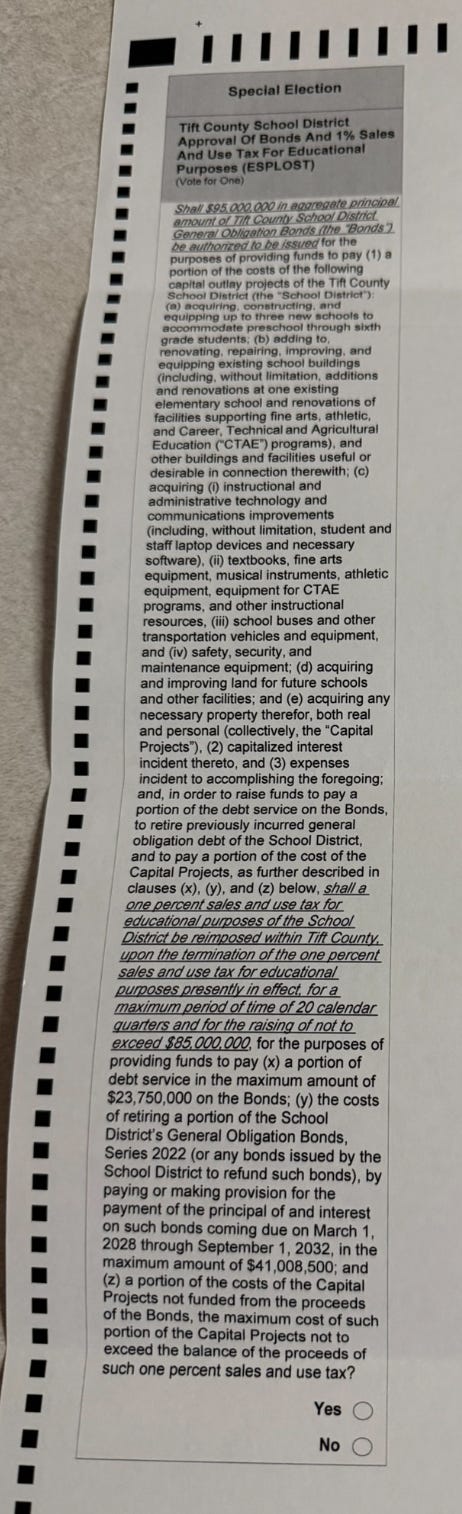
What does the text say? Read below (apologies in advance):
Special Election
Tift County School District
Approval Of Bonds And 1% Sales And Use Tax For Educational Purposes (ESPLOST)
(Vote for One)
Shall $95,000,000 in aggregate principal amount of Tift County School District General Obligation Bonds (the “Bonds”) be authorized to be issued for the purposes of providing funds to pay (1) a portion of the costs of the following capital outlay projects of the Tift County School District (the “School District”): (a) acquiring, constructing, and equipping up to three new schools to accommodate preschool through sixth grade students; (b) adding to, renovating, repairing, improving, and equipping existing school buildings (including, without limitation, additions and renovations at one existing elementary school and renovations of facilities supporting fine arts, athletic, and Career, Technical and Agricultural Education (“CTAE”) programs), and other buildings and facilities useful or desirable in connection therewith; (c) acquiring (i) instructional and administrative technology and communications improvements (including, without limitation, student and staff laptop devices and necessary software), (ii) textbooks, fine arts equipment, musical instruments, athletic equipment, equipment for CTAE programs, and other instructional resources, (iii) school buses and other transportation vehicles and equipment, and (iv) safety, security, and maintenance equipment; (d) acquiring and improving land for future schools and other facilities; and (e) acquiring any necessary property therefor, both real and personal (collectively, the “Capital Projects”), (2) capitalized interest incident thereto, and (3) expenses incident to accomplishing the foregoing; and, in order to raise funds to pay a portion of the debt service on the Bonds, to retire previously incurred general obligation debt of the School District, and to pay a portion of the cost of the Capital Projects, as further described in clauses (x), (y), and (z) below, shall a one percent sales and use tax for educational purposes of the School District be reimposed within Tift County, upon the termination of the one percent sales and use tax for educational purposes presently in effect, for a maximum period of time of 20 calendar quarters and for the raising of not to exceed $85,000,000, for the purposes of providing funds to pay (x) a portion of debt service in the maximum amount of $23,750,000 on the Bonds; (y) the costs of retiring a portion of the School District’s General Obligation Bonds, Series 2022 (or any bonds issued by the School District to refund such bonds), by paying or making provision for the payment of the principal of and interest on such bonds coming due on March 1, 2028 through September 1, 2032, in the maximum amount of $41,008,500; and (z) a portion of the costs of the Capital Projects not funded from the proceeds of the Bonds, the maximum cost of such portion of the Capital Projects not to exceed the balance of the proceeds of such one percent sales and use tax?
Alright, that’s a wall of text—but what does it actually mean? And could they have made this easier to understand?
Yeah… they could have.
Something like this:
“Do you agree to let the school system borrow money and keep a 1% sales tax for a few more years to build new schools, fix old ones, and buy things like buses, computers, and equipment?”
Boom. Done. No law degree required.
A More Detailed Breakdown if You Really Want to Know
They want permission to do two main things:
1. Borrow money (up to $95 million)
This would be through bonds (basically a loan the school system pays back over time).
The money would be used for things like:
Building up to 3 new schools (Pre-K through 6th grade)
Fixing and upgrading current schools
Improving things like:
classrooms
fine arts and sports facilities
career/technical education programs
Buying:
laptops and technology
textbooks and equipment
school buses
safety/security equipment
Buying land for future schools
2. Continue a 1% sales tax (ESPLOST)
This is a 1% extra sales tax you already pay in Tift County.
They want to:
Keep it going after the current one expires
Run it for about 5 years (20 quarters)
Collect up to $85 million
That tax money would be used to:
Help pay back the loan (bonds)
Pay off some older school debt
Cover any remaining costs of the projects
Simple way to think about it
A YES vote means:
The school system can borrow money
The 1% school sales tax continues
They move forward with building, upgrades, and purchases
A NO vote means:
No new borrowing
The sales tax does not continue
Those projects may not happen (or would need another plan)
Why I prefer Absentee Ballots
When Georgia updated its election laws to allow no-excuse absentee ballots, I jumped at the chance to vote by mail. Despite what some people believe, it’s safe, efficient, and has helped increase voter turnout across the board. Investigations from both sides over the years have not found widespread fraud with mail-in voting.
I like it because it gives me time—time to learn about the issues, research what I don’t fully understand, and make an informed decision. Compare that to standing at a voting machine with a wall of legal text staring back at you, just trying to vote and get on with your day.
When something is written in such a complicated, hard-to-understand way, it raises questions. It shouldn’t be that difficult for voters to clearly understand what they’re being asked to decide.
Final Thoughts
It’s not enough just to show up and vote. The right to vote is something we should value—because not everyone in the world has it. But that right comes with responsibility. We should be informed about the issues we’re voting on.
And when ballot language is this confusing, it feels intentional. It shouldn’t be this hard to understand what you’re voting for.